
USING OPENFOAM TO STUDY FLOW PAST TANDEM CYLINDERS
Motivation and Impact
Cylindrical shapes are common in many aerodynamic and hydrodynamic structures. In these structures, there is considerable interaction between the components. Hence, studying the canonical problem of flow past tandem cylinders has a profound impact on understanding the flow physics and developing better numerical models for the prediction of the forces on these structures.
Problem Definition
When two cylinders of the same diameter are placed in tandem, the aerodynamic forces on the downstream cylinder is governed by the ratio of the spacing between the cylinders (L) to their diameter (D) and the flow Reynolds number (Re). When L/D < 2.4, the two cylinders behave as a single bluff body and the well-known von-Karman vortex shedding occurs only from the rear cylinder. On the other hand when L/D>4, both the cylinders behave like independent bodies and vortex shedding is observed from each of the cylinders. When the ratio lies between these ratios, the vortex shedding from the upstream cylinder can be intermittent or periodic depending on the ratio and the experimental conditions. When the Reynolds number is added as another parameter in addition to the L/D ratio, the problem is complicated further as the flow separation can be laminar or turbulent. Considering the number of parameters and scenarios, it is not possible to perform all these studies experimentally. Hence numerical simulations, validated using carefully performed experiments is required to provide a detailed explanation of the flow physics for all possible flow configuration.
Mathematical Modeling
Computational fluid dynamics is the numerical solution of the non-linear partial differential equations governing the fluid flow (Navier-Stokes equations). These equations can be applied for both laminar and turbulent flows (determined by Reynolds number). This approach is referred to as direct numerical simulation (DNS). However, the computational cost of these simulations scale as with the Reynolds number. For practical applications, the Reynolds numbers are very high (Re > 1e7) and the flow is turbulent. It is impossible to solve the governing equations directly with the computing power available currently. Hence, additional empirical/mathematical modeling of turbulence is required to reduce the computational cost.
Turbulence modeling has three main types: (i) large eddy simulation (LES), (ii) Reynolds-averaged Navier-Stokes (RANS), and (iii) Hybrid modeling. LES can accurately predict the forces to within 5-10% of DNS. The computational cost of LES scales as away from the solid walls and as near the wall. This makes LES attractive away from the wall while still impossible near the wall. On the other hand, the computational cost of RANS scales as which makes it very attractive for industrial applications. However, there are a number of deficits in RANS modeling which can result in the erroneous prediction of the forces. To improve the accuracy of force predictions while maintaining lower cost, hybrid methods have been developed. The hybrid methods employ RANS modeling near the wall and LES away from the wall. This reduces the computational cost by around 100 times compared to LES. A carefully performed hybrid methods can predict the forces to within 5-15% of the DNS.
Numerical Method
All the numerical simulations were performed using the open-source CFD software OpenFOAM. The grids required for the simulations were generated using the open-source grid generator GMSH. As the current study was performed using a novel hybrid turbulence model, the model was implemented as a dynamic library and linked at run-time to OpenFOAM.
Results
In this numerical study, RANS and hybrid turbulence modeling are compared for the accurate prediction of the lift and drag forces on tandem cylinders for three separation ratios (L/D=1.4, 3.03, and 3.7). Vorticity (first row) and Q (second invariant of velocity gradient tensor, second row) are shown for the three cases. The vorticity results showed good agreement with the PIV measurements (not included here, Q not measured).
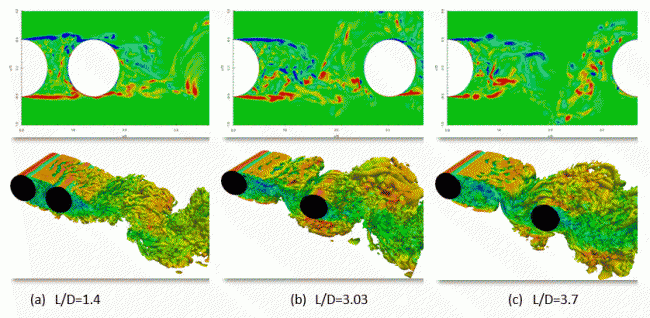
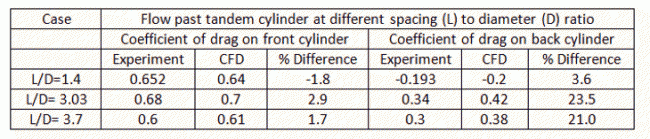
Our initial simulations using the hybrid models also showed good agreement with measured drag forces on each cylinders. The large differences observed for some of the results are due to the differences in the methods used to trigger turbulence. The RANS results showed a difference of around 20-25%.
Most of the above simulations were performed using the HPC cluster. The use of the cluster reduces the waiting time as multiple simulations can be run simultaneously. OpenFOAM-2.3.x has been compiled on the cluster using Intel compilers and openmpi.
